Want to learn how to play Disney Lorcana? On this page you'll find the complete rules explained in plain English: from shuffling your deck to winning with 20 lore. We explain every step of a turn, show you how to read a card and list all the keywords. Ideal if you've just bought a starter deck, or if you want to quickly look up a rule during a game.
Updated in October 2026, according to the official rules (Comprehensive Rules) by Ravensburger.
Contents
The goal of the game
In Lorcana you are an Illumineer: with magical ink you summon Disney characters, called glimmers. With those characters you go on adventures to collect lore. The first to reach 20 lore wins immediately.
You can also lose without your opponent reaching 20 lore: if your turn ends while you have no cards left in your deck, you lose. In practice this rarely happens, but with decks that draw a lot of cards it's good to know.
What do you need?
- A deck of at least 60 cards per player. A starter deck is a ready-made deck of 60 cards. You can also take a complete deck or build one yourself.
- Something to track lore. For example the lore counter from a starter deck, a die or our free online lore counter on your phone.
- Damage counters. Small tokens or dice to mark damage on characters and locations. Damage stays until it is removed.
- Optional: sleeves, a deck box and a playmat, so your cards stay in good shape.
Lorcana is usually played with two players. A game takes about 20 to 40 minutes. Ravensburger recommends the game from age 8.
How to read a Lorcana card
There are four kinds of cards: characters, actions (including songs), items and locations. A character card contains the most information:
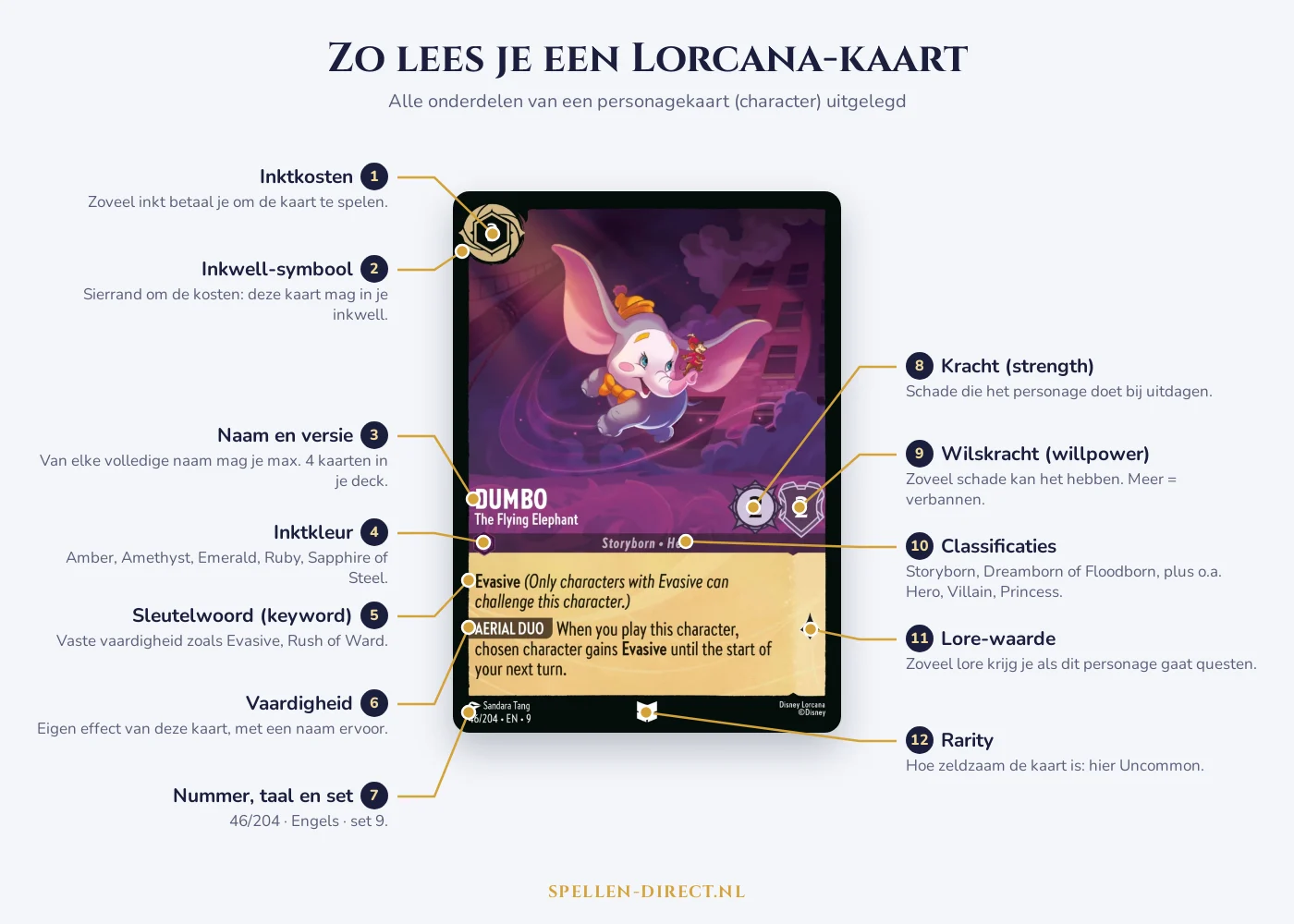
- Ink cost (top left): the amount of ink you pay to play the card.
- Inkwell symbol: the ornate border around the cost. Only cards with this border may be put into your inkwell.
- Strength (the sword icon): the damage the character deals when it challenges or is challenged.
- Willpower (the shield): how much damage the character can take. If it has that much damage or more, it is banished.
- Lore value (the diamonds on the right): how much lore you get when the character quests.
- Classifications: Storyborn, Dreamborn or Floodborn, and traits such as Hero, Villain or Princess. Some cards refer to them.
- Keywords and abilities: the text in the bottom part. All keywords are explained further down.
If a card says something different from the rules, the card text takes precedence.
The play area
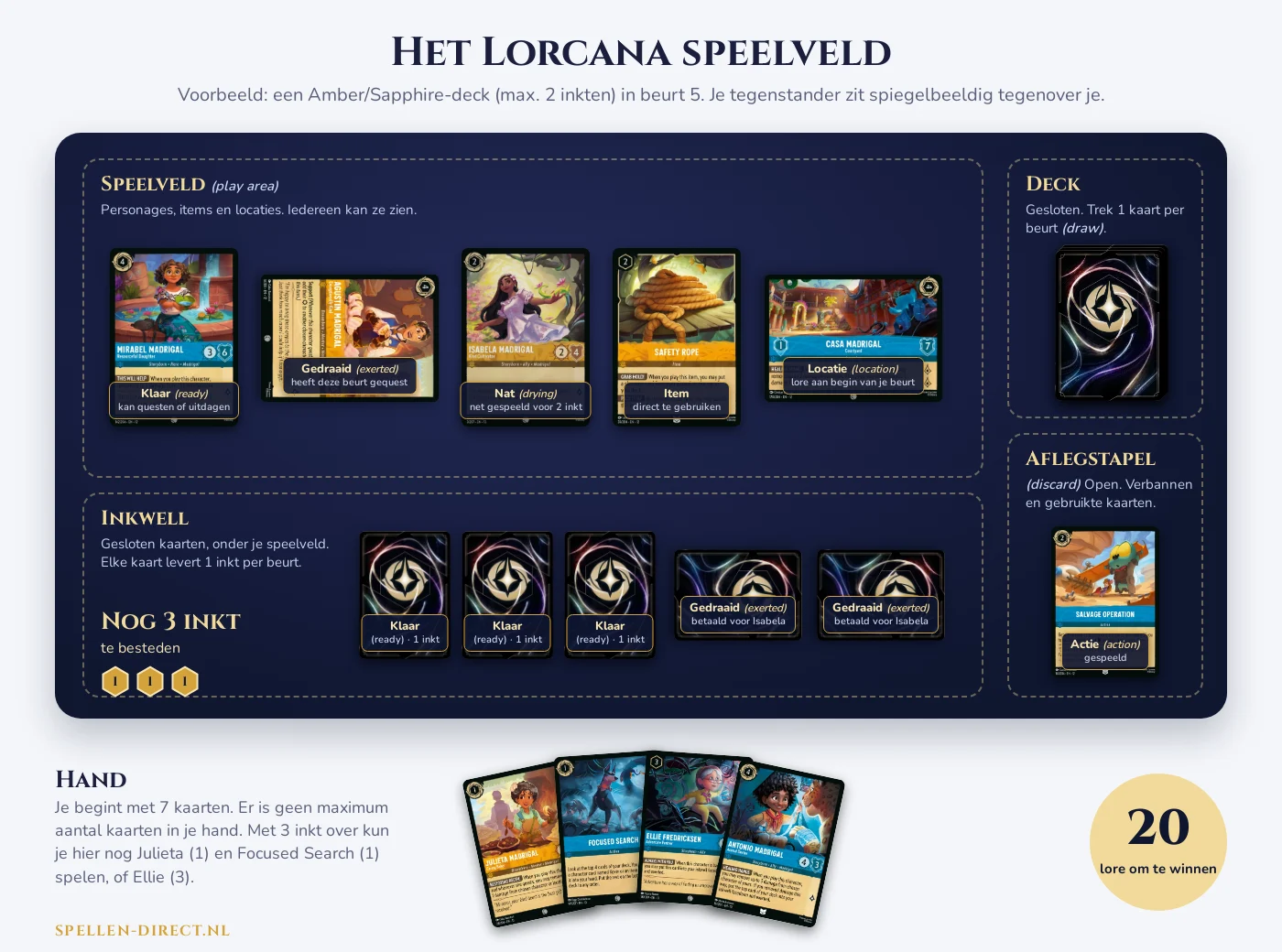
- Deck: your face-down draw pile.
- Hand: the cards you can play. There is no maximum hand size.
- Inkwell: a row of face-down cards below your play area that provide your ink.
- Play area: your characters, items and locations.
- Discard pile: face-up pile with banished cards and played actions.
A card you use is turned sideways: it is then exerted. An upright card is ready.
Setup: how to start
- Both players shuffle their deck and place it face down.
- Randomly decide who goes first, for example with a die or a coin.
- Both draw 7 cards.
- Mulligan: not happy with your opening hand? Starting with the first player, each player may once put as many cards as they like face down at the bottom of their deck. Then draw back up to 7 cards and shuffle your deck.
- Both set your lore to 0. The first player starts, but does not draw a card on their very first turn.
The course of a turn
Every turn consists of three phases. You make the most important decisions in the main phase.
1. Beginning phase: Ready, Set, Draw
- Ready: ready all your exerted cards, including those in your inkwell.
- Set: effects that happen “at the start of your turn” trigger. Your locations now give you their lore.
- Draw: draw one card. (The first player skips this on the first turn of the game.)
2. Main phase
In the main phase you do as many of these actions as you can and want, in any order:
- Put one card into your inkwell (at most once per turn).
- Play cards by paying ink.
- Quest with your characters to earn lore.
- Challenge: attack your opponent's characters or locations.
- Sing songs with your characters.
- Use abilities of characters, items and locations.
- Move characters to a location by paying the move cost.
3. End of turn
Effects that happen “at the end of the turn” trigger and effects that last “this turn” end. Then it's your opponent's turn. Note: damage on characters stays, it doesn't disappear at the end of the turn.
Ink and the inkwell
Ink is the “mana” of Lorcana. You need it to play cards and use some abilities.
- Once per turn you may put a card with the inkwell symbol from your hand into your inkwell. You briefly show the card to your opponent and then place it face down.
- Every ready card in your inkwell provides 1 ink. To pay, you exert as many inkwell cards as the cost.
- Cards in your inkwell stay there for the rest of the game. So choose wisely which card you sacrifice.
- You don't have to ink every turn, but early on it's almost always wise.
Example: on turn 3 you have 3 cards in your inkwell. You can then play one card costing 3, or a card costing 2 plus a card costing 1.
Playing cards
Characters
You play a character by paying its ink cost. A character that has just entered play is still drying: the ink has to dry. Until the start of your next turn it can't quest, challenge or sing and can't use abilities that require exerting it. Your opponent can challenge a drying character once it is exerted. Characters with Rush may challenge right away.
Actions and songs
You play an action, the effect happens immediately and the card goes to your discard pile. A song is a special action: you can simply pay for it with ink, or have a character sing it. You then exert a dry character with an ink cost equal to or higher than the cost of the song, and play the song for free.
- Singer 5 means this character sings songs as if it costs 5.
- Sing Together songs can be sung by several characters at once, as long as their combined cost is high enough.
Items
Items stay in the play area. They give an ongoing advantage or an ability you can use. Items don't need to dry: you may use their ability on the turn you play them.
Locations
Locations are places your own characters can go to. They work like this:
- If a location has a lore value, you get that lore at the start of your turn (in the Set step).
- You move a character to your location by paying the move cost in ink. You may also move a character you've just played.
- Characters at a location often gain extra abilities from that location.
- Your opponent can always challenge a location, even if it isn't exerted. A location deals no damage back. If it has as much damage as its willpower, it is banished.
Questing: earning lore
Questing is how you win. Choose a dry, ready character and exert it. You immediately gain lore equal to that character's lore value (the diamonds). An exerted character can't do anything else this turn, and your opponent can challenge it on their turn. So questing is always a trade-off: grab lore or keep your character safe.
Challenging
By challenging you attack your opponent's characters or locations. It works like this:
- Choose a dry, ready character of your own and exert it.
- Choose an exerted character of your opponent (or a location). You can't challenge a ready character.
- Both characters simultaneously deal damage equal to their strength to each other. Put damage counters on the cards.
- If a character has as much damage as its willpower or more, it is banished and goes to the discard pile.
Example: your character with strength 3 and willpower 4 challenges an exerted character with strength 2 and willpower 3. You deal 3 damage, so your opponent's character is banished. Your character takes 2 damage and survives, with 2 damage that stays on it.
Watch out for Bodyguard (you must challenge an exerted Bodyguard character first if you can) and Evasive (only characters with Evasive or Alert may challenge this character).
Shift: letting characters grow
Some characters have Shift with their own cost, for example “Shift 5”. You may then play such a character for that Shift cost on top of a character with the same name that you already have in play. The new character takes over the state of the old one:
- If the old character was already dry, the new one can quest or challenge right away. That's the great power of Shift.
- If the old character was exerted, the new one also enters play exerted.
- Damage on the old character remains.
- If the character is banished, all cards in the stack go to the discard pile.
There are also variants: with Universal Shift you may shift onto any of your own characters, and with [classification] Shift onto any character with that classification.
All keywords explained
Keywords are fixed abilities that appear on many cards. The reminder text in brackets is also on the card itself. This is what they mean:
| Keyword | What it does |
|---|---|
| Alert | This character can challenge as if it had Evasive, so it can also challenge characters with Evasive. |
| Bodyguard | May enter play exerted. When your opponent challenges, they must choose a character with Bodyguard if able. |
| Boost N | Once per turn you may pay N ink to put the top card of your deck face down under this card. Other abilities use those cards. |
| Challenger +N | Gets +N strength while challenging. The bonus doesn't count when this character is itself challenged. |
| Evasive | Can only be challenged by characters with Evasive (or Alert). |
| Reckless | Can't quest. You can't end your turn while this character is ready and can challenge something. |
| Resist +N | Damage dealt to this character or location is reduced by N. |
| Rush | May challenge on the turn it is played. Questing still has to wait until it is dry. |
| Shift N | Play this character for N ink on top of one of your characters with the same name. Read more about Shift. |
| Singer N | Counts as a character costing N when singing a song. |
| Sing Together N | You may sing this song by exerting several characters with a combined ink cost of at least N. |
| Support | When this character quests, you may add its strength to another chosen character's strength this turn. |
| Vanish | When your opponent chooses this character for an action, it is banished. |
| Ward | Your opponents can't choose this character for effects. Challenging is still allowed. |
Glossary of terms
Because Lorcana cards are often in English, you'll hear English terms at the table. These are the most important ones, with the Dutch term:
| English | Dutch | Meaning |
|---|---|---|
| Lore | Lore | Points. With 20 lore you win. |
| Ink / Inkwell | Inkt / inktpot | Your “money” for playing cards. |
| Inkable | Inkbaar | Card with the inkwell symbol, may go into your inkwell. |
| Exert / Exerted | Draaien / gedraaid | Turn a card sideways to use it. |
| Ready | Klaar | Card is upright and can be used. |
| Drying / Dry | Nat / droog | A character that was just played and can't quest or challenge yet. |
| Quest | Questen | Exert a character to earn lore. |
| Challenge | Uitdagen | Attack an exerted character or a location. |
| Banish | Verbannen | Send to the discard pile. |
| Strength | Kracht | How much damage a character deals. |
| Willpower | Wilskracht | How much damage a character can take. |
| Discard | Aflegstapel | Face-up pile of banished and used cards. |
| Glimmer | Glimmer | A character in the world of Lorcana. |
| Illumineer | Illumineer | You, the player. |
| Storyborn / Dreamborn / Floodborn | – | Classifications: the original character, a new version, or a version from the flood of chaotic ink. |
Deck building rules
- Your deck has at least 60 cards. More is allowed, but most players keep it at exactly 60.
- You use cards of at most two inks.
- Of each card with the same full name (name plus version, such as “Dumbo – The Flying Elephant”) you may have at most 4 copies in your deck.
- Make sure most of your deck is inkable, otherwise you'll run short of ink.
- Include enough cheap cards (cost 1 to 3) so you can do something in the first turns.
Not sure whether your deck is legal? Have it checked for free with our deck check, or start with one of our complete decks. Missing a card? You'll find it in the single cards.
Common beginner mistakes
- Questing or challenging with a drying character. Wait until your next turn, unless the character has Rush (and then only challenge).
- Challenging a ready character. You can only challenge exerted characters (locations always).
- Inking more than one card per turn. It's one at most.
- Forgetting that the first player doesn't draw on turn 1.
- Removing damage at the end of the turn. Damage stays until an effect removes it.
- Singing with a drying character. Singing is also only possible once the character is dry.
- Forgetting location lore. You get it at the start of your turn, not when you play the location.
Frequently asked questions about the Lorcana rules
How much lore do you need to win?
You win as soon as you have 20 lore. That happens immediately, even in the middle of your turn.
Can you put more than one card into your inkwell per turn?
No. Once per turn you may put a card with the inkwell symbol from your hand into your inkwell. Some card effects let you put extra cards into your inkwell, but that is then stated on the card.
What happens when my deck is empty?
If your turn ends while your deck is empty, you lose the game. So an empty deck alone is not enough to lose.
Can I challenge a character that isn't exerted?
No. You can only challenge exerted characters. You can always challenge locations.
Can a character quest on the turn you play it?
No, it has to dry first. From your next turn it can quest. Rush lets a character challenge right away, but not quest.
Does damage go away at the end of the turn?
No. Damage stays on a character or location until an effect removes it, or until the card leaves play.
How many cards do you need to play Lorcana?
Each player needs a deck of at least 60 cards, with at most two inks and at most 4 copies of the same card. A starter deck is ready to play straight away.
Are there Dutch Lorcana cards or rules?
Lorcana is not published in Dutch. In the Netherlands and Belgium people usually play with English cards. The Dutch version of this page explains the official English rules in Dutch.
Where can I find the official rules?
Ravensburger publishes the full Comprehensive Rules (in English) on the official Disney Lorcana website. When in doubt: the text on the card takes precedence over the general rules.
Ready to play? Check out our boosters, complete decks and single cards. New to Lorcana? Also read what Disney Lorcana is, with all inks, rarities and sets.